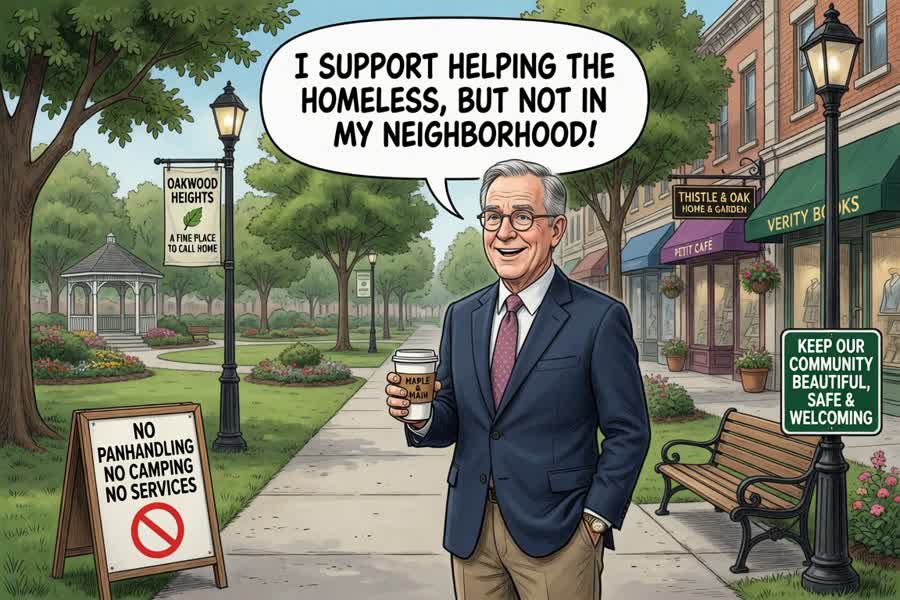
STEP housing, equity, NIMBYism, and smart allocation of resources
The Washington State legislature passed several bills meant to encourage or force municipalities to equitably allocate land and money towards low-income housing.
-
HB 1220 (2021) created the substantive requirement. Cities and counties planning under the Growth Management Act must assess projected housing need by income bracket—including moderate-, low-, very-low-, and extremely-low-income households—and make “adequate provisions” for that housing in their comprehensive plans and development regulations.
-
SB 5148 (2025) added enforcement. The Department of Commerce can review selected local housing plans and development regulations for compliance. A jurisdiction found noncompliant may face funding consequences, and under specified circumstances it may be prevented from denying qualifying affordable- or moderate-income housing developments.
- HB 2266 (2026) substantially preempts city and county authority over what the bill calls STEP housing: Shelter, Transitional housing, Emergency housing, and Permanent housing.
At today’s Mercer Island farmer’s market, two of our state legislators, My-Linh Thai and Janice Zhan, fielded questions from constituents who were upset about the way HB 2266 prevents local municipalities from negotiating more flexible region-wide solutions to homelessness. The constituents acknowledged that we all need to contribute towards addressing the society-wide problem of homelessness and drug addiction. But, they argued, why can’t Mercer Island contribute money, for example, towards the construction and maintenance of STEP housing in some other community (e.g., Eastgate in Bellevue? Renton? North Bend? Puyallup?)? Such a more rural and less affluent community will have lower land prices and, so, would support the housing of more homeless people. Housing one homeless person in Medina might cost $10,000,000. The same unit built in Puyallup might cost $350,000. Furthermore, the constituents say that it is bad policy to build low-barrier low-income housing close to schools and residential areas. SB 2266 prevents municipalities from prohibiting such placement. Isn’t it better to put low-income housing in more commercial or rural zones?
The constituents set up a petition to our state legislators calling for changes to state laws so that local municipalities can restrict placement of low-income housing.
Similar discussions are common on the social network nextdoor.com.
How HB 2266 ties cities’ hands
For transitional and permanent supportive housing, a city must allow it in every zone where it permits ordinary residences or hotels.
For indoor shelters and emergency housing, a city must allow them wherever hotels are allowed—and in additional zones when necessary to accommodate the projected need identified in the city’s comprehensive plan.
More importantly, cities generally may not subject STEP housing to:
-
stricter development or operating standards than ordinary residential or lodging uses in the same zone;
-
a more burdensome permit or environmental-review process;
-
discretionary design review or a predecision public hearing; or
-
special conditions imposed through ordinances, development agreements, or other legal agreements.
Thus, a city could not say, for example, “Apartments are allowed here, but supportive housing requires a special-use hearing, extensive neighborhood approval, larger setbacks, 24-hour private security and a special operating agreement.” Those differential requirements would generally be prohibited.
NIMBYism versus smart allocation of resources
I believe that one motivation behind HB 1220, HB 5148, and HB 2266 is to prevent communities from resorting to NIMBYism: Not In My Backyard! Almost nobody wants low-income housing, especially low-barrier housing, in their neighborhood. It’s fundamentally unfair, the argument goes, for rich folks to be able to buy their way out of the obligation to support such people and to force poorer and less politically powerful communities to face the burdens and costs (e.g., crime) from such housing.
It’s unfair for Seattle to have to bear most of the burden of dealing with homelessness.
So, not only should rich people contribute money towards helping homeless people — only the most sociopathic libertarians would disagree with that obligation — but also rich communities must be forced to have some low-income people live in their midst.
Without stringent statewide laws, even if every municipality agrees that affordable housing is necessary, each municipality will find a reason why its own neighborhoods are uniquely unsuitable. Without a statewide or regional allocation, wealthy communities can use large minimum lots, apartment bans, height limits, minimum distance from schools, procedural delays, parking requirements and other ostensibly neutral rules to keep most lower-income households outside their boundaries. Meanwhile, less affluent communities (e.g., the International District in Seattle) will inherit a disproportionate share of subsidized housing, shelters and social-service costs.
Perhaps the cheapest place to build low-income housing is in rural areas. But such areas will be far from jobs, far from support services, and will lack the supportive communities and infrastructure of urban and suburban areas.
On the other hand, for a significant subgroup of homeless people, access to jobs is a non-issue, since those people are too physically and mentally sick to hold down a job. Furthermore, the choice isn’t between locating homeless shelters in rural areas versus locating them in urban areas. The homes could be located in exurban areas or in small cities where housing prices are low and where support services would be present.
Affluent communities often have better schools, lower crime, parks, better environmental quality, political resources and access to influential social networks. Excluding low-income families from those places can perpetuate intergenerational inequality. Concentrating poor people in areas far from rich people deprives the poor people and their children of a chance to grow out of poverty.
My Opinion
I have sympathy with both the equity argument and the cost-effectiveness argument. The equity argument, which the state legislature apparently adopted, says rich communities must share not only the financial responsibility to contribute towards building and maintaining low-income housing and services but also the lifestyle costs. The cost-effectiveness argument says: to house more homeless people, put them where land is cheaper. I don’t know if there’s an easy way for future legislation to balance those two desiderata in a way that doesn’t reward NIMBYism and privilege.