
The Pentagon announces the U.S. Prayer Force
Department of War Announces Establishment of U.S. Prayer Force.
New faith-based combat initiative will “restore spiritual dominance across all battlespaces.”
WASHINGTON, D.C. — The Department of War today announced the establishment of the United States Prayer Force, a new joint military initiative designed to integrate battlefield prayer, strategic supplication, and faith-based force multiplication into America’s national defense posture.
The Prayer Force, informally known inside the Pentagon as “the Kneeling Eagles,” will operate under the newly created Office of Spiritual Superiority and will coordinate with combatant commands, chaplain corps personnel, defense contractors, and selected congressional faith-leadership caucuses.
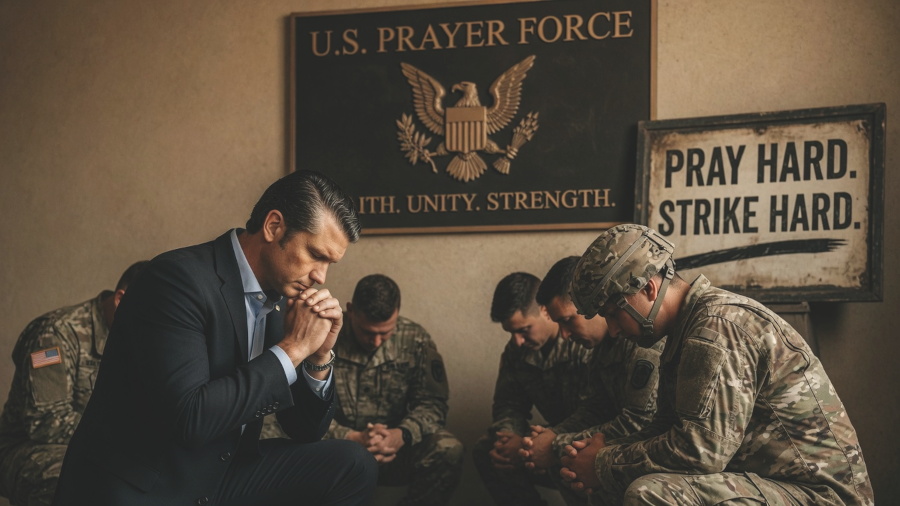
AP News photo
Its official motto will be:
“Pray Hard. Strike Hard.”
Defense Secretary Pete Hegseth praised the new force as “a long-overdue restoration of biblical confidence, martial courage, and American dominion.”
“For too long, our military has treated prayer as a support function,” Hegseth said. “This administration recognizes prayer as an offensive capability. When America kneels before God, our enemies should consider that a warning.”
Hegseth added that the Prayer Force would help reorient U.S. strategy around “faith, firepower, and holy resolve.”
“We are not merely defending territory,” he said. “We are contending for civilization. The Lord did not give America aircraft carriers, drone fleets, and global basing rights so we could be timid.”
According to the Department, the Prayer Force will be tasked with supporting U.S. missions through “synchronized, full-spectrum intercession,” including pre-deployment blessings, battlefield-targeted prayer surges, divine-favor assessments, and post-operation moral confidence briefings.
“The modern battlespace is multidimensional,” said Lt. Gen. Brent Halloway, Acting Deputy Undersecretary for Intercessory Readiness. “We already operate on land, at sea, in the air, in space, and in cyberspace. It would be irresponsible not to consider the prayer domain.”
Defense officials emphasized that the Prayer Force will not replace conventional military capabilities, but will serve as a “low-cost, high-conviction supplement” to existing weapons systems.
“Faith is a force multiplier,” said Col. Mason Briggs, commander of the pilot program at Fort Righteous. “A missile can strike a target, but prayer can sanctify the mission. That kind of overmatch cannot be measured by ordinary metrics, which is exactly why we need a new metrics office.”
The Pentagon confirmed that early-stage Prayer Force doctrine includes the following operational concepts:
- Preemptive Intercession: Prayer conducted before intelligence is fully confirmed.
- Close Air Supplication: Coordinated prayer support for air operations.
- Rules of Spiritual Engagement: Guidelines for determining when divine assistance may be requested.
- Miracle Readiness Training: Exercises designed to prepare personnel for unexpected favorable outcomes.
- Dominion Support Operations: Prayer missions intended to establish “righteous authority” over contested populations.
- Faith-Based Battle Damage Assessment: Post-mission review to determine whether victory, escalation, or confusion should be classified as providence.
A senior defense official, speaking on background, said the program emerged after internal reviews concluded that “thoughts and prayers had been underutilized as a national security instrument.”
“Historically, thoughts and prayers have been deployed after tragedies,” the official said. “This initiative moves them forward in the kill chain.”
Members of Congress offered immediate support.
Rep. Clay Markham, chair of the House Subcommittee on Defense Innovation, praised the announcement as “long overdue.”
“For too long, America has asked God to bless our troops without giving those blessings a proper command structure,” Markham said. “This initiative finally brings accountability, procurement discipline, and congressional oversight to the miracle space.”
Sen. Rebecca Calhoun, co-sponsor of the Faith Through Firepower Act, said the Prayer Force would restore America’s “moral clarity.”
“Our adversaries must understand that the United States will defend freedom with every tool at its disposal,” Calhoun said. “That includes aircraft carriers, sanctions, special operations, and the direct attention of the Almighty, properly requested through authorized channels.”
Calhoun also praised the Prayer Force’s recruitment slogan:
“Join the Few, the Proud, the Prayerful.”
“This is exactly the message our young people need,” Calhoun said. “They need to know that service is not only about weapons proficiency. It is also about kneeling with discipline, praying with confidence, and understanding that American power is a sacred trust.”
Not all lawmakers were supportive.
Sen. Miguel Alvarez questioned whether the new force violated constitutional principles or basic sanity.
“Does the Pentagon now believe God needs a liaison office?” Alvarez asked. “And if so, why does that office require $3.7 billion, four regional headquarters, and a no-bid contract with Blessed Dynamics?”
Pentagon officials rejected criticism that the Prayer Force blurs the line between church and state.
“This is not about establishing a religion,” said Assistant Secretary Dana Whitcomb. “This is about establishing dominance. The distinction is very important.”
Whitcomb added that the program would be “fully inclusive,” allowing service members of different faiths to participate, provided their prayers remain “mission-aligned, command-approved, and compatible with U.S. strategic objectives.”
But Prayer Force personnel who wish to remain anonymous said Christian prayer is given emphasis.
Michael L. Weinstein, director of the Military Religious Freedom Foundation and former Air Force officer, criticized the initiative for giving precedence to Christian prayers. “What about Muslim, Jewish and Buddhist prayers?” Weinstein also suggested that prayer be directed towards avoiding war, not just towards winning war.
Matteo Bruni, official spokesman and Director of the Holy See Press Office Vatican News for Pope Leo XIV, says that Pope Leo XIV plans to release a statement in opposition to the use of prayer for military purposes.
The Department also announced plans for a new training curriculum at the Intercessory Combat Operations School. Recruits will receive instruction in battlefield theology, emergency kneeling procedures, classified hymn selection, spiritual escalation management, prophecy deconfliction, and PowerPoint-based moral certainty.
A preliminary recruitment campaign is expected to launch next month with a series of slogans, including:
“Pray Hard. Strike First.”
“Putting the Amen in Armament.”
“Onward, Christian Soldiers — With Air Support.”
“Blessed Are the Peacemakers — After We Win.”
“Ask, and It Shall Be Given; Target, and It Shall Be Droned.”
“No Quarter. No Mercy. No Sermon Too Long.”
Defense contractors have already expressed interest in supporting the new program. Industry analysts expect rapid growth in the divine-readiness sector, including prayer analytics software, encrypted devotional platforms, ruggedized field rosaries, tactical kneeling pads, autonomous hymn-selection systems, and cloud-based miracle dashboards.
A consortium led by Blessed Dynamics, Shield of Faith Systems, and Raytheon Liturgical Solutions has reportedly submitted a proposal for the Pentagon’s first integrated Prayer Operations Platform.
The platform, known as GOLIATH, would provide real-time supplication tracking, battlefield blessing optimization, and AI-assisted scripture selection for commanders seeking “maximum spiritual effect with minimal theological latency.”
The contractor’s proposed slogan is:
“The Battle Belongs to the Lord. Logistics by Blessed Dynamics.”
Shares of several major defense firms rose following the announcement.
At a Pentagon briefing, reporters asked whether the Prayer Force would be evaluated using measurable outcomes.
Lt. Gen. Halloway said the Department was developing “a robust framework for assessing the correlation between prayer tempo and favorable kinetic events.”
Asked whether unfavorable outcomes would indicate ineffective prayer, flawed strategy, or divine disapproval, Halloway replied, “That question is currently under review.”
Secretary Hegseth dismissed concerns that the initiative might encourage religious triumphalism inside the armed forces.
“America does not apologize for victory,” Hegseth said. “We do not apologize for strength. We do not apologize for the God of battles. Our enemies should know that when we say ‘amen,’ we mean it operationally.”
The Prayer Force’s first deployment exercise, Operation Enduring Amen, is scheduled for later this year. The exercise will test the unit’s ability to provide 24-hour prayer coverage during simulated combat operations, budget hearings, cable news appearances, and congressional investigations.
In closing remarks, Col. Briggs said the new unit reflects America’s enduring commitment to military innovation.
“Our enemies should know this,” Briggs said. “We will meet them on every battlefield — physical, digital, spiritual, and appropriations-related. We will out-pray them, out-spend them, and, when necessary, out-source them.”
The Department concluded its announcement with a final statement of purpose:
“Spiritual Dominance Across All Battlespaces.”